Commercial Roofing for Public Agencies in Miramar, FL
A public roof scope has to show what the agency is approving, where work will happen and what remains unknown. We inspect drains, seams, curbs, edges and reported interior leaks, then mark the repair boundary with photographs. Miramar's land-use legend distinguishes industrial and commercial areas, employment centers and office parks, along with regional-activity and transit-oriented designations. In Opa-locka downtown, Ali Baba Avenue forms the industrial spine and the Tri-Rail station is a regional transit hub. Before drafting a scope, we inspect the agency building and connect observed roof conditions to procurement steps.
Public agencies often need a record that can move through facilities, procurement and budget review. We identify confirmed work, testing that could change quantity, and approval points for concealed conditions. A Miramar roof review establishes field conditions and access. For a district with schools, a school district roof plan can organize conditions by building while preserving each school's findings.
Which code edition belongs in the review?
Florida's statewide reference is the 2023, eighth edition of the Florida Building Code; the published effective date was December 31, 2023. The project team should confirm the code requirements and permitting path that apply to its specific scope. We document the existing assembly and proposed roof work so the agency's design and building officials can review the details. The project file can list the code edition, reviewed assembly details and open questions for the agency’s design team.
A scope may need membrane type, attachment, insulation, edge metal, drainage and penetration details stated separately. If the existing roof layers are unknown, we identify testing before final quantities. A roof inspection records visible conditions and access limits. A roof survey can support planning when an agency is evaluating a building before a larger capital decision.
What should a bid package make clear?
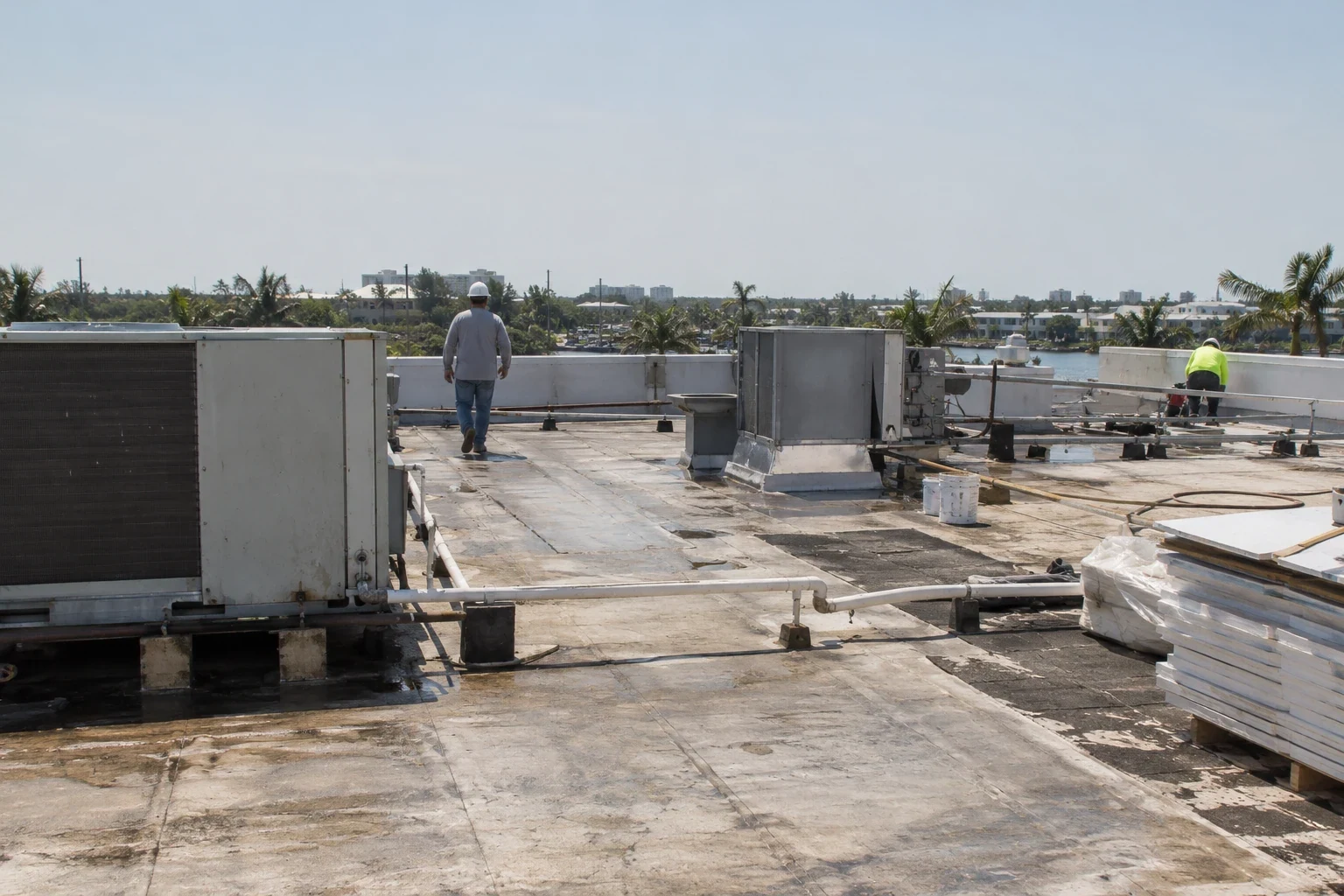
Useful quantities begin with defined roof zones and observable conditions. We identify where removal is expected, where a test opening is needed and which details require trade coordination. If wet insulation or deck damage is concealed, the package can set an approval process for added work after opening. Photos, marked plans and material notes help reviewers compare bids without treating unverified conditions as fixed quantities.
Miramar's principal network includes State Road 7, US 27, I-75 and the Turnpike, with I-95, I-595 and SR 826 nearby. Before delivery, confirm the agency site's security, loading and roof-access rules with its site contact. A general contractor roof scope can align trade sequence and submittal needs. We identify where another trade must move equipment or complete a curb change before the membrane is closed.
How can a public building remain available?
A library, administrative office, maintenance shop or clinic may have different access controls and hours. We confirm the work zone, roof entry, staging and protection below with the facility contact. A lift near an entrance or loading area can require a defined work window. Each shift has an opening limit and a dry-in point so the building is not left with exposed roofing.
Miramar's planning map also marks employment and office settings separately from industrial and commercial uses, with regional-activity and transit-oriented areas identified. In Opa-locka downtown, Ali Baba Avenue is the industrial spine and the Tri-Rail station is a regional transit hub. We document each agency site’s operation and roof access before setting the work sequence. A occupied-building work plan can identify notices, protection and daily closure points.
What records help after a storm?
For public buildings, the inspection log should identify the reported weather date and record drain, edge and attachment observations by roof zone. After an event, we inspect perimeter attachment, seams, curbs and drains, then photograph observed movement and water entry. The record distinguishes a temporary measure from completed permanent repair.
South Florida’s tropical-cyclone and severe-weather threats make post-storm checks of roof attachments, drainage and water entry relevant to commercial assets. We tie the inspection to the building and roof zone rather than infer damage from a weather report. A storm damage roof assessment documents field conditions. Record the occupied area, entry point and procurement contact, then define approvals before setting a roof-work sequence.
More about Public Agencies
How should the agency compare repair options?
Repair is suitable when the surrounding membrane is sound, insulation is dry and the tie-in can reach stable material. Broader wet areas, repeated failures, unstable attachment or deck concerns can make replacement worth comparing. We separate repair quantities from test-dependent work and state what finding would change the scope. That gives reviewers a basis for approval without hiding uncertainty in a general allowance.
Cost and timing change with tear-off depth, insulation, deck repairs, edge details, drainage, staging, access and occupied-space protection. A repair estimate can state confirmed tasks. A replacement assessment compares recover and tear-off when the existing roof supports those options. The agency can retain quantities and assumptions for procurement review.
What belongs in the public project file?
Keep the marked roof plan, dated photographs, materials, inspection notes, approvals and closeout record together. Note areas not reached safely and any test that remains open. The file should show what was completed, what was deferred and why an added condition required approval. That helps facilities staff maintain the property after project administration is complete. It can also retain the bid scope, submittals and change documentation beside the field record. When several buildings are funded in phases, a consistent set of photographs and quantities helps reviewers track the decision from initial inspection through final closeout. The agency can use that record to plan routine drain and edge checks between capital projects. A dated inspection schedule can assign each visit to a facilities contact and preserve follow-up.
At turnover, we review the repaired details and remaining maintenance needs with the agency contact. A condition report can carry observations into the next budget cycle. Public agency roofing may also depend on a restoration documentation record when a storm claim is involved. Schedule a Miramar public building roof review. We will document condition, approvals and the work sequence so the agency can evaluate its next step.
Commercial Roofing Questions
Can you prepare quantities for a public bid?
We can document roof zones, observed conditions, visible details, access limits and test needs. Quantities that depend on concealed insulation or deck conditions should be identified as approval items. The agency's design and procurement team determines the bid structure and review requirements.
How should an agency handle conditions found after tear-off?
The work plan should name who may approve added work and what documentation is needed. We photograph the opening, mark its location and state the added material and quantity before proceeding beyond the approved boundary. Temporary protection can be maintained while the agency reviews the change when conditions allow.
Does a weather event prove a public roof was damaged?
No. After a reported event, we inspect the roof for attachment movement, open seams, punctures, drainage issues and interior water, then document those observations by building and roof zone. The report separates storm findings from prior wear and identifies further testing if needed.
Can public buildings remain open during reroofing?
The facility's use, roof zone, access and protection requirements determine the sequence. We coordinate work windows, material routes and daily dry-in with the site contact. The agency manages public notices and any temporary restrictions while we define the roofing tasks and closure points.
What closeout records should a public owner receive?
A marked roof plan, photographs, installed materials, repair limits, approvals, inspection notes and remaining maintenance items make a useful file. We identify areas not accessed and conditions that need follow-up. That helps facilities staff connect future leaks to completed work.
Miramar, Pembroke Pines, Davie, Hollywood, Opa-locka, Miami Gardens, Miami Lakes and Doral in Broward and northern Miami-Dade County.
Request a Roof Assessment
Send the building address and what the roof is doing. We reply with a roof visit date and a written scope.